Technique · 9 min read
How to make salted caramel that never seizes
Dry caramel in four stages, what to do when it turns to a lump, and why pale caramel tastes of nothing at all.
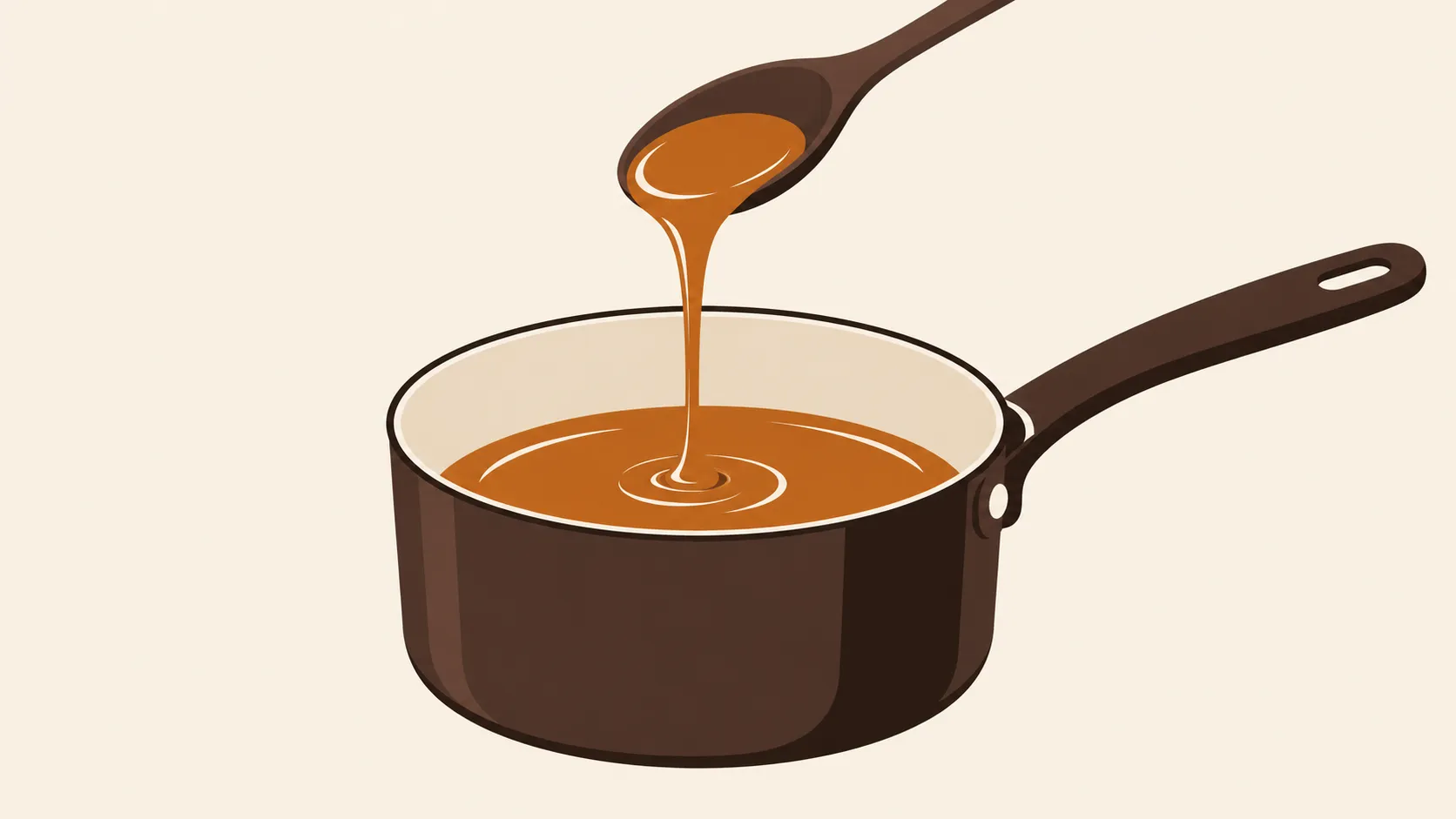
Caramel is sugar taken to the edge of burning. That is the whole recipe. Butter, cream and salt are all added afterwards to turn it into a sauce, and none of it is difficult once you know what you are looking at.
The process is lopsided. For five minutes nothing appears to happen, then everything happens at once: the useful window runs from about 160°C to about 182°C, and a pan crosses those 20°C in under three minutes.
Three faults ruin most batches: crystallisation while the sugar melts, seizing when the dairy goes in, and splitting afterwards. All three are recoverable. Only burning is not.
Dry or wet?
Wet caramel dissolves the sugar in water first. It is more forgiving of a distracted cook, but it takes longer and the water has to boil off before anything browns.
Dry caramel melts the sugar alone. It is faster, tastes deeper, and is what every recipe on this site uses. The risk is that it browns unevenly if you leave it alone for too long.
The depth is worth explaining. A wet caramel holds water, so the pan sits at one temperature and every molecule has the same history: one clean note. A dry caramel holds several temperatures at once, and swirling folds them together, so you taste the spread rather than a point on it. That unevenness is also why it blackens underneath if you walk away.
The four stages
Put 200 g of caster sugar in a heavy-based pan over a medium heat. Do not stir it. Then watch for:
- Clear edges, white middle (2 to 3 minutes). The sugar at the pan’s rim liquefies first. Swirl the pan gently, and do not reach for a spoon.
- A pale straw syrup (4 to 5 minutes). Most of the sugar is liquid now, with a few lumps. Keep swirling; the lumps will dissolve.
- Golden, smelling sweet (6 to 7 minutes). This is where nervous cooks stop. Do not stop here, because it tastes only of sugar.
- Deep amber, the colour of an old penny, with the first wisp of smoke (7 to 9 minutes). Take it off the heat immediately. It will continue darkening for another twenty seconds from the pan’s own heat.
Those four stages are two chemical processes end to end.
Stages one and two are inversion, not melting. Sucrose has no clean melting point. Heat, moisture and the sugar’s own acidity split it into glucose and fructose, and that invert sugar liquefies lower and will not readily crystallise again, which is why the first liquid stays liquid and the lumps dissolve into it.
Stage three is caramelisation starting. Around 160°C those two sugars lose water and their fragments recombine: diacetyl first, the buttery note, then furans and maltol, toasted and nutty. Interesting, and still one-dimensional.
Stage four is where the flavour is. Past 175°C the fragments join into large brown molecules carrying colour and a controlled bitterness. That bitterness is the point: it stops caramel tasting like golden syrup, and the salt sharpens it. Past 190°C nothing balances it and the sauce tastes of ash.
If you own a thermometer: stage 4 is about 180°C. Above 190°C it is bitter and beyond rescue.
The temperature ladder
Fahrenheit is rounded to the nearest 5, as it is in the recipes.
| Stage | °C | °F | What you have |
|---|---|---|---|
| Soft crack | 132 to 143 | 270 to 290 | Colourless, a thread that bends |
| Hard crack | 149 to 154 | 300 to 310 | Palest straw, shatters cold |
| First colour | 160 to 165 | 320 to 330 | Caramelisation begins |
| Light caramel | 165 to 170 | 330 to 340 | Honey gold, one-note |
| Medium amber | 170 to 178 | 340 to 350 | The first bitterness |
| Deep amber, the target | 178 to 182 | 350 to 360 | Old penny, a wisp of smoke |
| Too far | 185 to 190 | 365 to 375 | Mahogany, acrid, thin |
| Burnt | above 190 | above 375 | Black edges, throw it away |
Measuring is awkward: 200 g of molten sugar is only 4 mm deep in a 20 cm pan, so keep the probe tip in the liquid and off the metal, which reads higher.
Finishing the sauce
Off the heat, whisk in 90 g of cubed butter one piece at a time. It will bubble violently. That is water in the butter hitting 180°C sugar, and it is normal. Then pour in 120 ml of warm double cream, still whisking, and stand back. Finally, a teaspoon of flaky sea salt.
Warm the cream. Cold cream into hot caramel is the single most common cause of a seized, grainy sauce.
The violence is measurable. Butter is about 16% water, so 90 g carries roughly 15 g, and water expands about 1,700 times as steam: near 25 litres of it, in seconds. One lump releases the lot at once; a cube at a time spreads it over half a minute.
The cream is a temperature difference. Fridge-cold cream is 4°C against caramel at 180°C, a gap of 176°C, and where they meet the sugar falls below its setting point faster than you can stir it away. Warm the cream to 60 to 70°C, where it steams without simmering, and the gap drops to about 115°C. Do not boil it, or the sauce sets thicker than intended.
Salt last, off the heat: a teaspoon of flakes, or half a teaspoon of fine salt, which packs denser. Taste it warm, because hot sugar mutes salt.
When it seizes
Sooner or later the whole thing will clench into a hard amber lump with butter floating on top. It looks ruined. It is not.
Put the pan back over a low heat and keep whisking. The lump re-melts within a minute or two and the sauce comes back together. If it stays split, whisk in a tablespoon of hot water.
Use the lowest heat you have, since that sugar is already fully cooked, and whisk continuously, because the fat insulates the lump. Seizing is a temperature fault: something cold set the sugar solid, and only heat unsets it.
The unfixable failure is the other one: burnt. Acrid, thin, black at the edges. Nothing recovers that: throw it away, soak the pan, start again. Two hundred grams of sugar costs almost nothing.
When it splits
A split sauce is a different fault with a different fix, which is why the two get confused. A seized sauce is lumpy and stiff. A split one is smooth, with a slick of clear fat on the surface and a grainy feel on the tongue.
The emulsion has failed. Fat sits in suspension in a sugar syrup, and three things break it: butter added too fast, boiling once the cream is in, and over-reducing, which leaves too little water to hold anything.
The fix. Off the heat, let the pan fall to around 80°C, about a minute. Then whisk in a tablespoon of hot water or of cold double cream, into the middle and outwards in small circles, adding a second only once the first has gone in. If whisking will not do it, thirty seconds with a stick blender submerged brings a split caramel back glossy.
If it is too thin, or too thick
Judge it cold. Caramel at 100°C pours like single cream and sets nearer honey, and most over-reduced batches were judged in the pan. Drop a teaspoon onto a cold saucer, chill it three minutes, and that is tomorrow’s texture.
Too thin cold, running off the slice onto the plate. Simmer it gently for three to five minutes, stirring, then test on the saucer again. If it is still slack, the cream was over-measured rather than the caramel under-cooked, and 20 g of butter whisked in off the heat will firm it.
Too thick cold, out of the jar in one lump. That is normal, not a fault: warm it and it pours. If it is still stiff warm, whisk in cream or milk over a low heat, about 15 ml per 100 g, a tablespoon at a time.
Why crystals form, and how to stop them
A single sugar crystal on the side of the pan can seed the whole syrup and turn it back to sand. Three defences:
- Swirl, never stir. A spoon carries crystals from the pan wall into the liquid.
- Brush the sides down with a wet pastry brush as it melts.
- A squeeze of lemon juice (a quarter teaspoon) in the sugar at the start breaks sucrose into glucose and fructose, which will not crystallise. This is insurance, not cheating.
The lemon speeds up the inversion above, and a partly inverted syrup gives a crystal no template to grow on. A teaspoon of golden syrup per 200 g does the same job. Crystals form while the sugar is melting, before any dairy is near it, and that is what separates this fault from seizing.
Scaling the batch
The ratio is 200 g sugar to 90 g butter to 120 ml cream, which is 100 : 45 : 60 by weight. Hold it, and the pan rather than the quantity is the limit: 200 g of dry sugar in a 20 cm pan is a layer about 7 mm deep, shallow enough to melt at one rate.
- Double it, 400 g: a 24 to 26 cm pan, not a taller layer in the same one. Expect 10 to 13 minutes rather than 7 to 9.
- Halve it, 100 g: a 16 cm pan, and stay with it. There is so little in there that it goes from gold to burnt in twenty seconds.
- More than 400 g: two batches. The edges darken before the middle is liquid.
A double batch holds its heat far longer, so stand the pan off the heat a full minute before the butter goes in, or the milk solids scorch.
Storing it
Salted caramel keeps for two weeks in a clean jar in the fridge. It sets firm when cold, so warm it in a pan or thirty seconds in the microwave, and it pours again.
Warm it gently and stir as it goes; a jar blasted for two minutes splits at the edges.
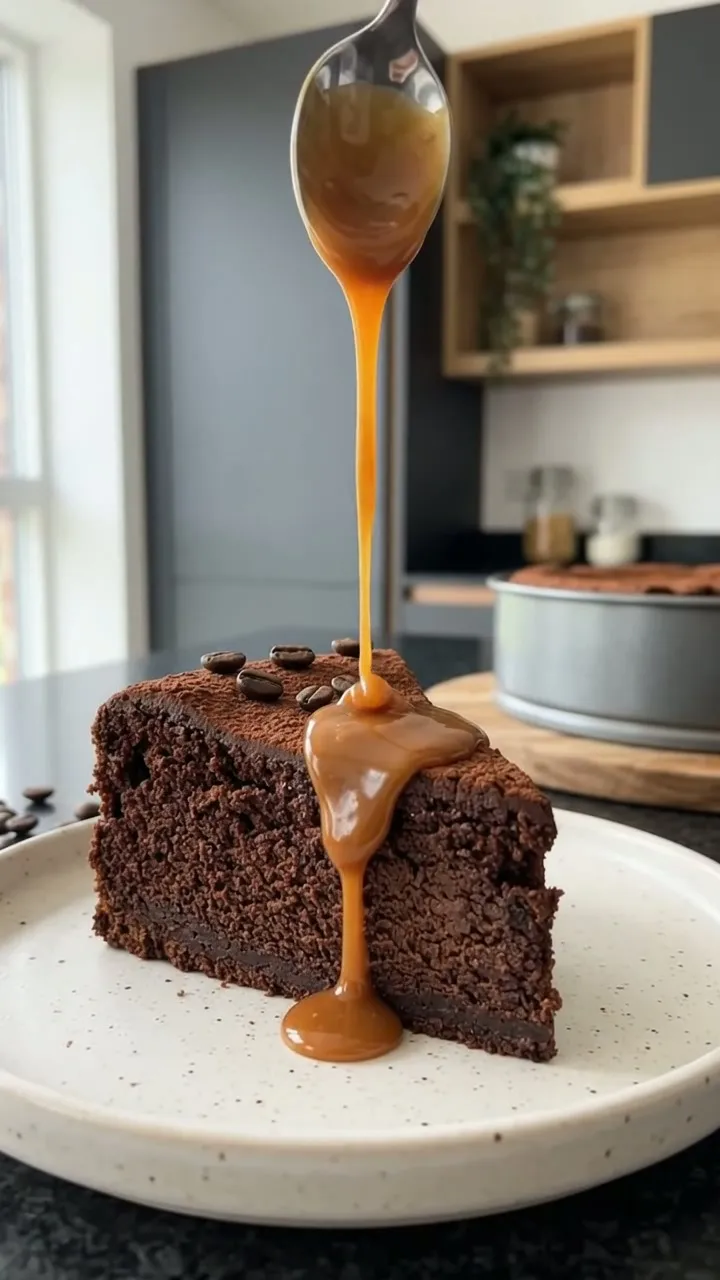
It is worth making a double batch. It goes on every cake in the caramel and coffee flavour, on ice cream, and on a spoon at eleven at night.