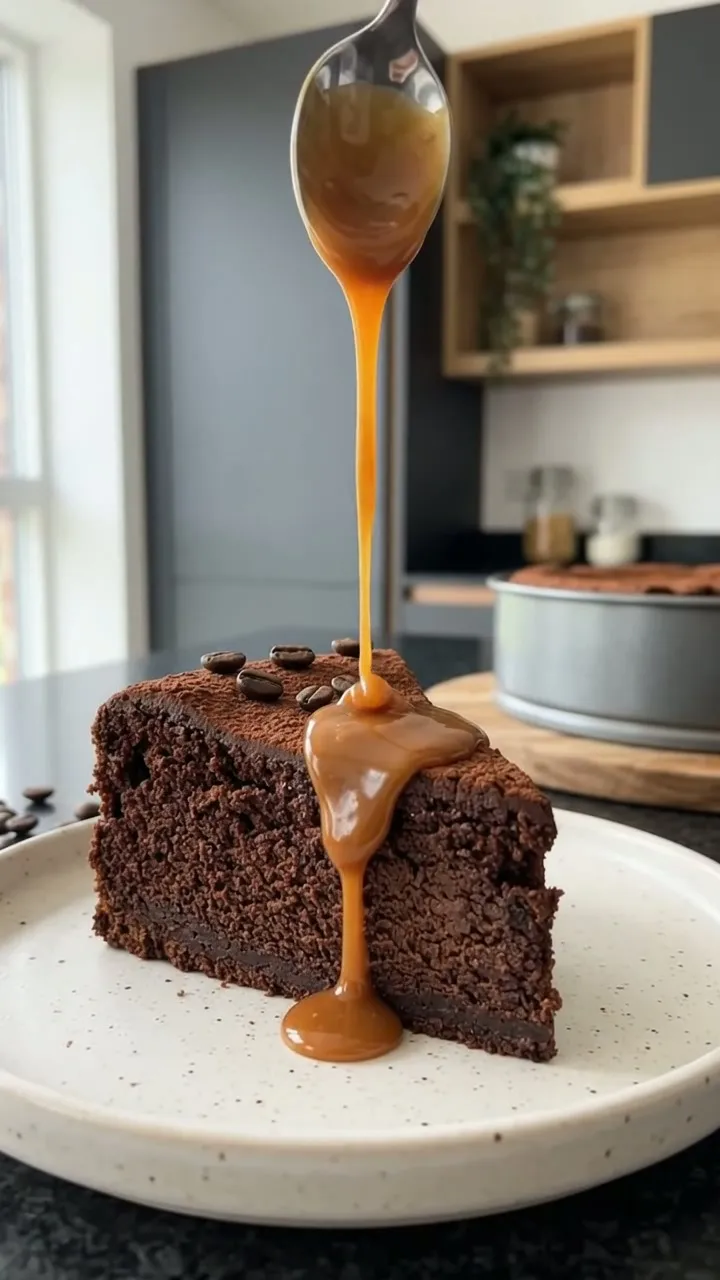
Chocolate Fudge Cake with Salted Caramel
A dark, dense chocolate cake built on the ratio two trusted bakeries agree on, deepened with hot coffee and finished with warm salted caramel poured over each slice.
- Total
- 1 hr 15 min
- Prep
- 25 min
- Bake
- 50 min
- Serves
- 10
- Level
- Easy
- Tin
- 20 cm springform
Most chocolate cake recipes are a guess wearing the clothes of a rule, so this one starts somewhere firmer. King Arthur’s Every-Occasion cake and their Simple and Rich cake are both built for the same 20 cm tin, and once you normalise them they land within fifteen grams of each other on flour and within one gram on sugar. Two recipes developed separately do not agree that closely by accident. The shape underneath them is real, and it is the shape this cake is built on.
Both of those make a layer meant to be stacked with another, and this site serves one cake cut into wedges, so the quantities here are scaled up to fill a springform properly. That sounds like a small decision and it is the one that ruins most scaled-up recipes. The batter comes out at 1,080 g, which is a lot of wet weight to get heat through, and a batter that heavy cannot set in the forty minutes a thin layer needs. It gets fifty. Give it less and you will cut into raw batter with a perfectly browned lid on top of it.
Fudgy is a texture with a cause rather than a compliment. It comes from a high proportion of sugar and fat to flour, which keeps the crumb soft, and from enough liquid that the starch swells fully instead of setting dry and open like a sponge. That is why the batter pours rather than drops off the spoon, and why the finished cake is dense and close-textured with a slight stickiness at the cut face. If you want something light and airy, this is the wrong recipe and no amount of extra whisking will change it.
The other thing worth knowing before you start is why the coffee is there. It is not to make the cake taste of coffee, and it will not. Cocoa is full of bitter compounds that read as flat and dusty on their own, and hot liquid poured over them opens them up, in the same way a pinch of salt makes caramel taste more of caramel. Use it hot, and use it strong.
The caramel is made during the twenty minutes the cake spends cooling in its tin, so nothing waits on anything else. It goes over each slice at the table, warm, rather than over the whole cake. A cake sauced in the kitchen arrives already soaking; a cake sauced in front of people is the best thirty seconds of the evening.
Where these quantities come from
This recipe was not invented at a keyboard. The ratio is converged from published recipes built for the same tin, then scaled and checked:
- King Arthur Baking, Every-Occasion Chocolate Cake, one 8 inch round, at least 2 inches deep
- King Arthur Baking, Simple and Rich Chocolate Cake, two 8 inch rounds, so halved below
Both references land within 15 g of each other on flour and within 1 g on sugar for the same tin, which is a strong signal that about 130 g flour and about 200 g sugar is the real shape of a single 20 cm chocolate layer.
Ingredients
For the cake
For the salted caramel
To finish
You will need
- 20 cm springform tin
- Balloon whisk
- Heavy saucepan
- Wire rack
Method
Oven 175°C · fan 155°C · 345°F
Heat the oven and line the tin
Heat the oven to 175C, 155C fan. Butter a 20 cm springform tin, line the base with baking paper, then butter the paper as well. This cake is fudgy enough to grip bare paper and tear on the way out. Brew the coffee now and leave it somewhere hot, because it needs to be genuinely hot when it meets the cocoa later rather than merely warm.
Tip If your oven runs hot, this is the recipe that will tell you. A batter this deep browns on top long before the middle has any idea what is happening.
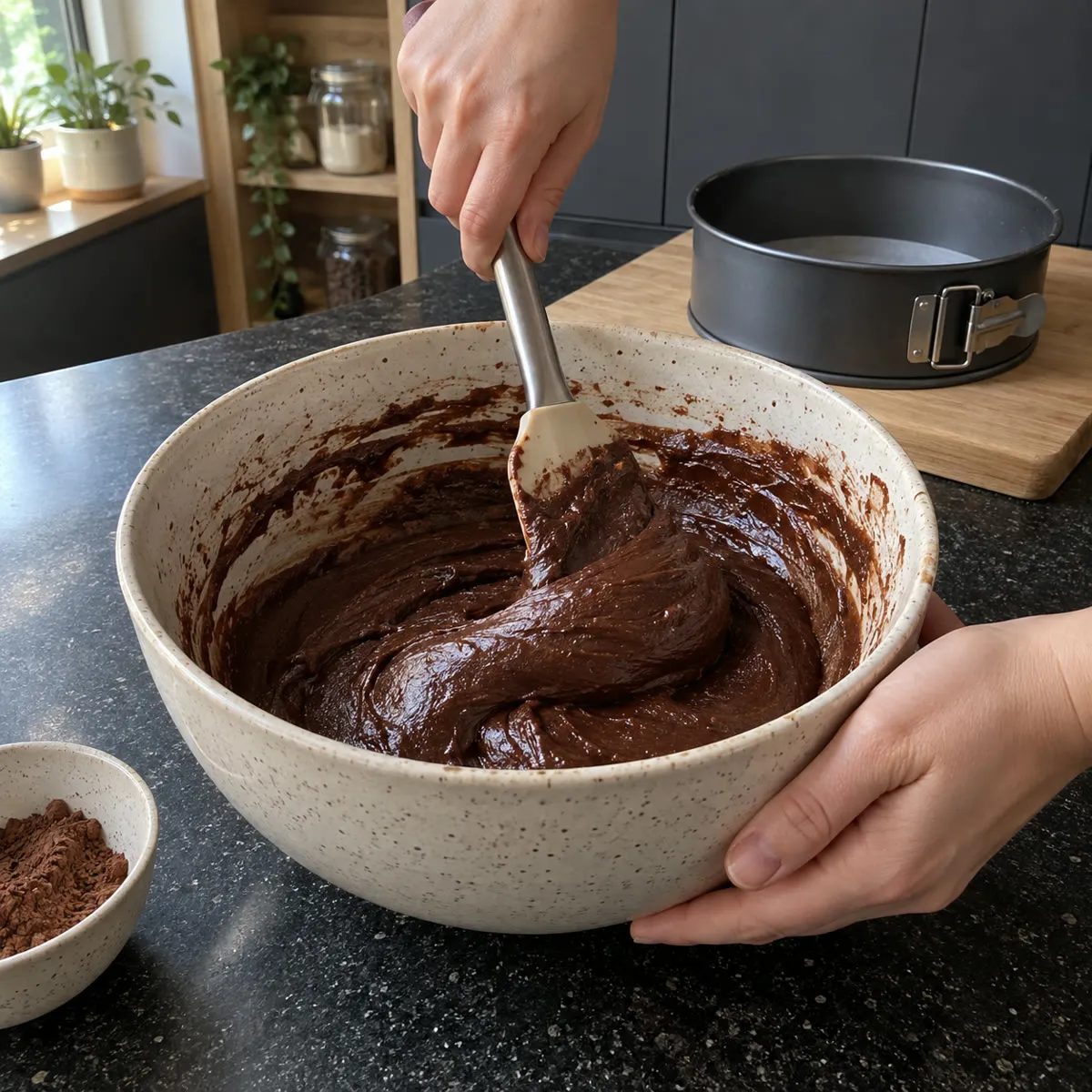
Whisk the dry ingredients
In your largest bowl, whisk together the 195 g flour, 40 g cocoa, 300 g sugar, the baking powder, the bicarbonate of soda and the salt. Keep going until the whole bowl is one even brown with no darker streaks anywhere, which takes longer than you expect, closer to a full minute of proper whisking. Push any lumps of cocoa against the side of the bowl and break them with the wires. A lump left now is a dry bitter pocket in a finished slice.
Tip Weigh the cocoa rather than spooning it. It packs down hard in the tub, and a heaped spoon can carry half as much again as a level one, which is enough to throw the liquid balance out.
Add the eggs, oil and buttermilk
Make a well in the centre and add the 3 eggs, the 110 ml sunflower oil, the 140 ml buttermilk and the vanilla. Whisk from the middle outwards, pulling the dry ingredients in a little at a time rather than all at once, until the batter is smooth and thick and falls from the whisk in a heavy ribbon. Stop the moment the last streak of flour disappears.
Tip Every stroke after the flour has gone develops more gluten, and gluten in a cake is elastic that pulls the crumb tight as it cools. Under-mixed beats over-mixed every time.
Pour in the hot coffee
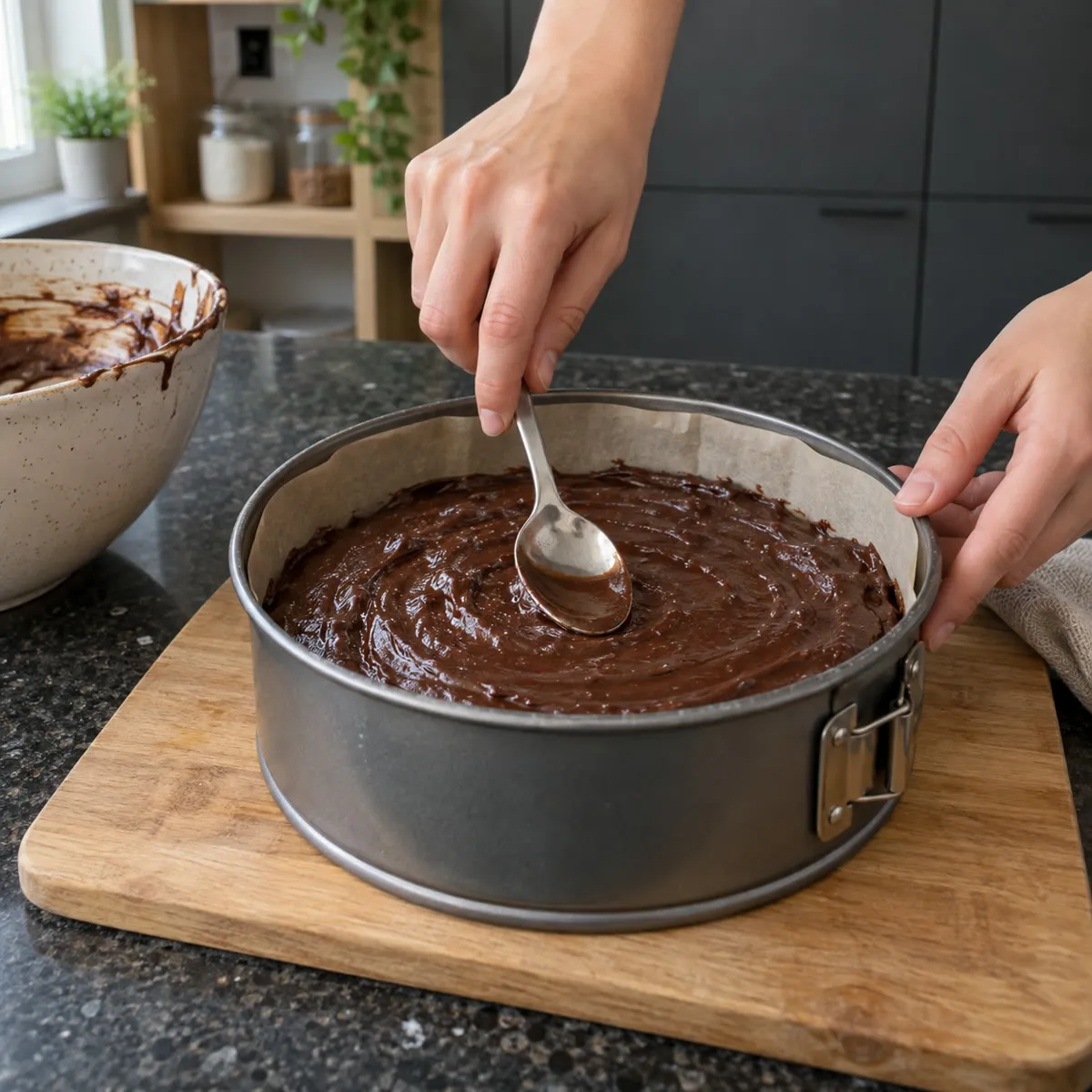
Pour the 120 ml of hot coffee down the inside edge of the bowl rather than straight onto the batter, and whisk it through. The batter will loosen dramatically, go glossy and very dark, and end up thin enough to pour rather than spoon. That is correct and it is the whole point, because a thin batter is a moist crumb. Pour it into the lined tin and level the top with the back of a spoon.
Tip Do not try to correct the consistency with more flour. What looks like a mistake here is the difference between fudgy and dusty.
Bake for 50 minutes
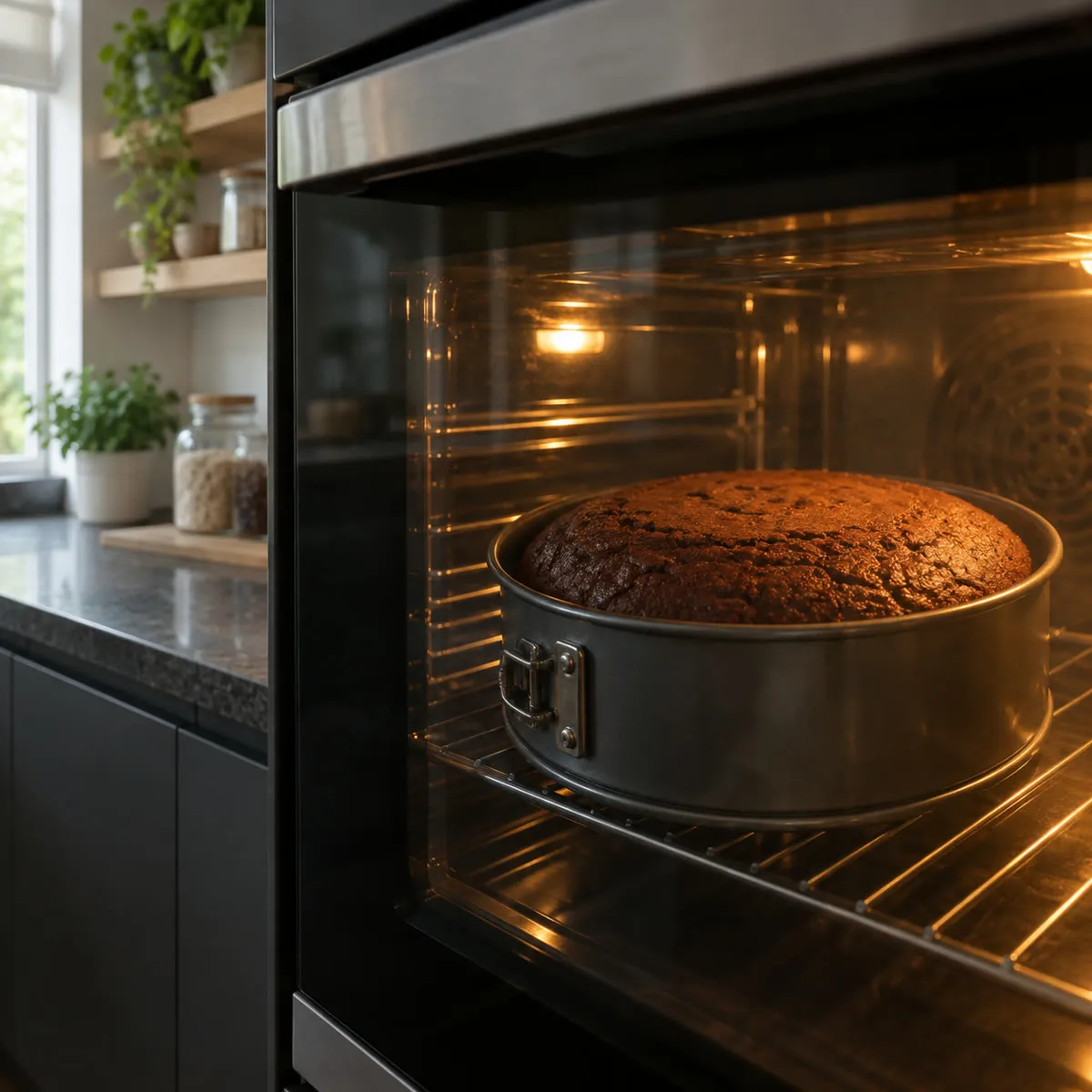
Bake for 48 to 55 minutes, and do not open the door for the first 25. This is a heavy batter and it needs the time: at 45 minutes the top will look completely finished while the centre is still liquid. It is done when the top springs back under a fingertip rather than holding the dent, and a skewer pushed into the middle, all the way down to the base of the tin, comes out with a few damp crumbs clinging to it but no wet batter.
Tip Test in the centre, then test again a few centimetres away. On a cake this deep a single clean reading near the edge tells you nothing at all.
Make the caramel while it cools
Leave the cake in its tin for 20 minutes. Meanwhile put the 200 g of sugar in a heavy pan over a medium heat and leave it alone, swirling the pan occasionally but never stirring, until it melts and turns a deep amber the colour of an old penny. Take it off the heat, whisk in the 90 g of butter a cube at a time, then pour in the 120 ml of warmed cream, which will bubble up hard and then settle. Stir in the flaky salt.
Tip Warm the cream first. Cold cream into hot sugar is the commonest cause of a seized, grainy caramel, and it seizes on contact.
Release the cake
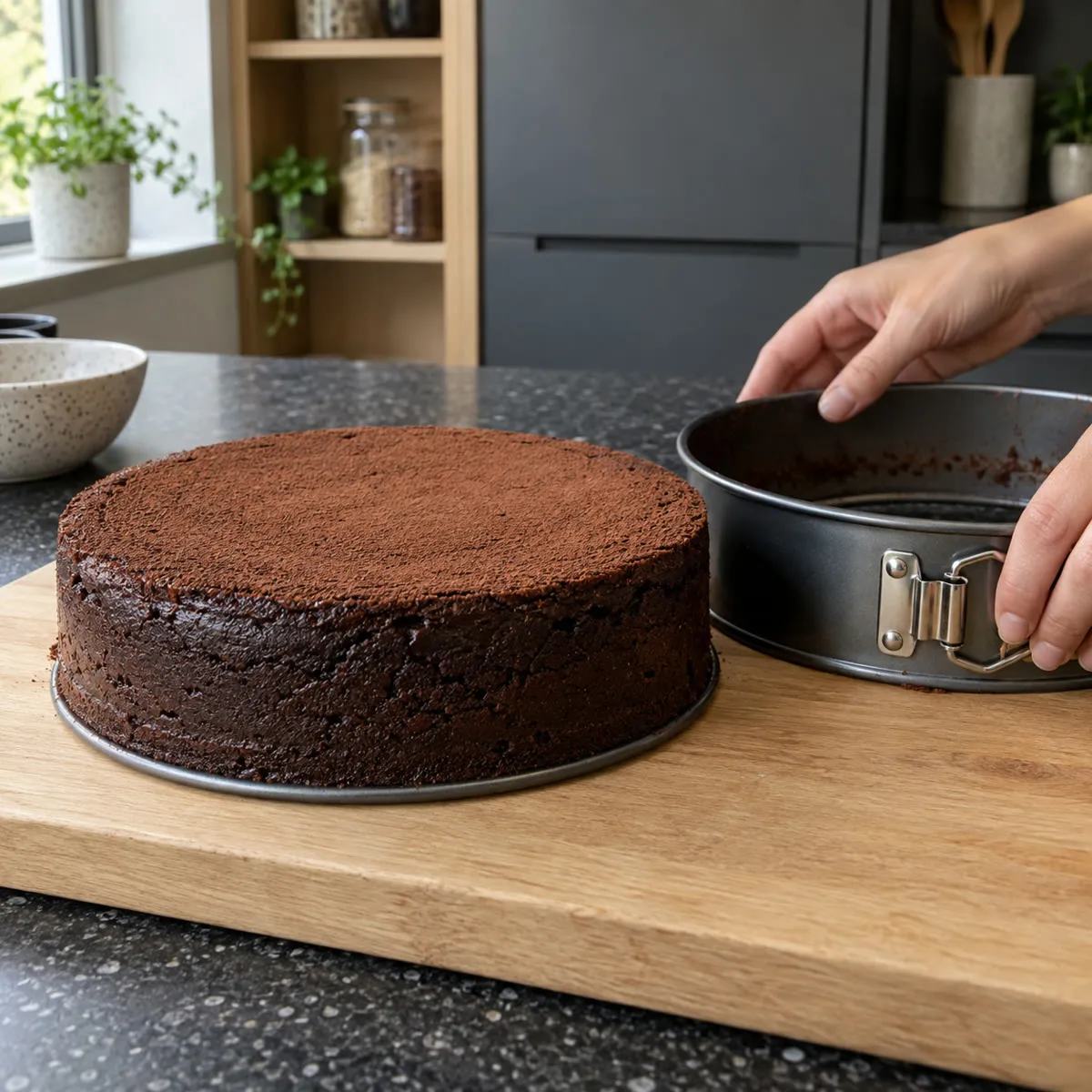
Run a thin knife around the inside edge of the tin, unclip the ring and lift it straight up, leaving the cake sitting on the tin base. Leave it there until it is cool enough to pick up in your bare hand. A cake is still setting as it cools, and moving it while the centre is hot is how the sides splay outwards and the middle drops, after all the care taken getting the bake right.
Tip Twenty minutes is the number to keep. Long enough for the crumb to firm up and let go of the tin, short enough that the residual steam has not condensed and made the base soggy.
Dust, slice and pour
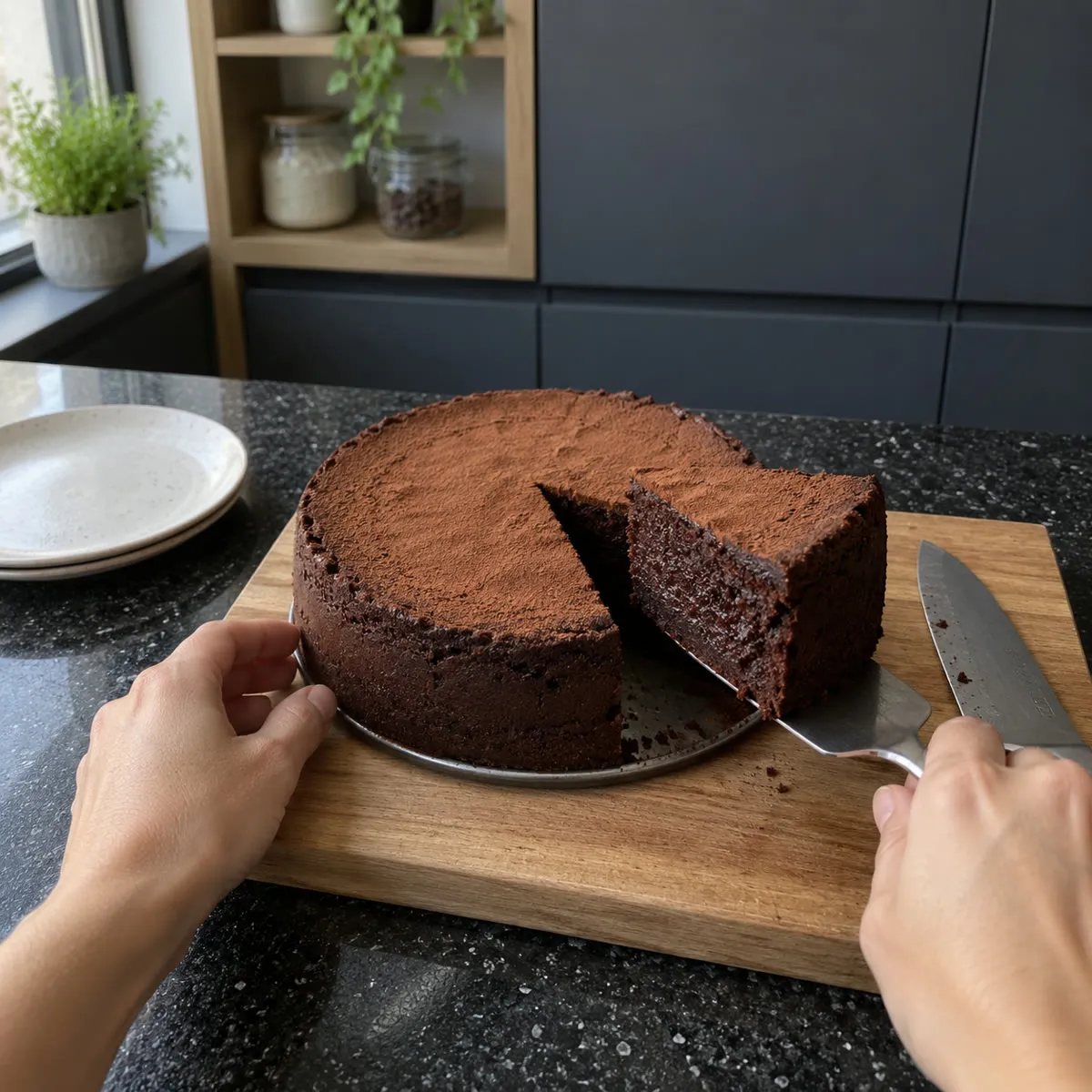
Dust the top with the 1 tbsp of cocoa through a small sieve, held high so it falls evenly rather than landing in a heap. Cut thick wedges with a large knife warmed under the hot tap and wiped dry between every cut, which gives clean faces instead of dragged crumb. Pour the warm salted caramel over each slice at the table.
Baker's notes
- The cake is better on the second day. The crumb tightens a little as the starch settles and the chocolate comes forward, so it is worth baking the day before if you have the choice.
- No coffee in the house? Use the same 120 ml of boiling water instead. You lose some depth and the texture is completely unchanged, so it is a fair swap rather than a compromise.
- For a dairy-free version, use oat milk soured with a teaspoon of lemon juice in place of the buttermilk, and make the caramel with coconut cream. The caramel will taste faintly of coconut, which suits the chocolate.
- This recipe contains dairy, egg and gluten. The caramel is dairy unless you make the coconut version. There are no nuts in it and nothing in it needs nuts.
- If you only have a loose-bottomed tin rather than a springform, it works, but stand it on a baking tray. This batter is thin enough to find any gap around the base and a slow leak onto the oven floor is a bad way to learn that.
Keeping it Keep the cake covered at room temperature for 3 days, with a piece of baking paper pressed against the cut face, which is where it dries fastest. It refrigerates for 5 days but bring it back to room temperature before serving, because cold hardens the fat and reads as dry. The caramel keeps for 2 weeks in a jar in the fridge and pours again after thirty seconds of gentle warming.
Questions, answered
Why is my chocolate cake dry?
Almost always over-baking rather than anything in the recipe. This cake is done when the skewer still carries a few damp crumbs, and it keeps cooking in the hot tin for several minutes after it leaves the oven. If you wait for a spotless skewer you have already gone several minutes too far. Start checking at 48 minutes rather than at 55.
Can I bake it as two layers instead?
Yes, and it is a good way to use it for a birthday. Split the batter between two 20 cm tins and bake for 25 to 30 minutes, testing from 25, because half the depth cooks in much less than half the time. Sandwich them with about a third of the caramel once both are completely cold, and pour the rest over the slices. The bake time changes because heat travels from the outside in, so halving the depth roughly halves the distance it has to cover, and a tray of cupcakes from the same batter needs barely twenty minutes.
My caramel went grainy. What happened?
A stray sugar crystal on the side of the pan fell back into the syrup and seeded the whole thing. Swirl the pan rather than stirring it, and brush the sides down with a wet pastry brush while the sugar is melting. If it has already gone grainy, put it back on a low heat with a spoonful of water and keep whisking, and it usually comes back.
Can I use natural cocoa instead of Dutch-processed?
You can, but they behave differently. Natural cocoa is acidic and reacts with the bicarbonate of soda, so the cake rises faster, sets sooner and tastes sharper and fruitier. If it is what you have, drop the bicarbonate of soda to a quarter teaspoon and expect a slightly lighter, less fudgy crumb.
The middle sank as it cooled. What went wrong?
Either the door was opened in the first 25 minutes, which drops the oven temperature far enough to collapse the foam before it sets, or it came out a few minutes early and the centre was not yet structural. Both are covered in the guide on why cakes sink in the middle. Worth knowing which one it was: a door-opening collapse leaves a wide shallow dip with a wet seam under it, while an early exit leaves a deeper crater and a centre that tastes underdone rather than merely sunken.
If it goes wrong
Three things account for most of what happens to a cake in a domestic oven. Each has its own guide.
- It sank in the middleSeven causes, told apart by the shape of the crater.
- It came out raw in the centreBrown outside, wet inside, and how to rescue the one you are holding.
- The caramel seizedIt is almost always fixable. The lump re-melts.